
What agentic AI transformation really looks like with real people at real companies
"I am building a cathedral, I am not just laying bricks."

Introduction
Last year, companies all over the world started getting serious about getting their people access to AI tools. In most cases, this looked like getting everyone access to enterprise versions of ChatGPT and/or Claude, and getting technical experts direct access to LLM APIs and Co-Pilot in VS Code. In leading-edge companies, developer access to coding agents like Cursor, Claude Code, Codex, etc., was common, as well as access to agent orchestration frameworks like LangChain, Claude Agent SDK, etc.
This year, everyone has realized that the tools were not enough; people need to know how to use them.
More than that, they need to understand the rapid pace at which the tools are evolving. They need to know the core concepts and code needed today to begin creating real business value.
In 2026, our team at AI Makerspace has been working with companies to help guide their transition into agentic AI. It is still unclear what the best product for any given company is, though we have experimented with a few different formats. I’m excited to announce that we’re partnering with AI Aspire to test additional formats. By bringing different types of assessments and ways of measuring success from within the AI Fund to leading companies, we have a unique breadth of view of what is working and what isn’t in 2026. If you’d like to chat about what might work for your organization, reach out with more information here.
For today, I’d like to talk about what matters right now and what I’ve learned so far.
What I’ve been learning
There are a few points that have stood out to me:
1. Anthropic is a trusted partner for large companies
2. New tools are being adopted faster than ever before
3. The “Aha” moment for everyone at your company is essential
4. Leading-edge people already exist at every organization
5. Big picture ideas abound, but MVPs are limited
6. Finally, the change that must be managed is something like:
a. Product must move towards engineering
b. Engineering must move towards product
c. Data science must bridge the gap
d. Organizations without “product” must embrace it
Anthropic is a trusted partner for large companies
Within the past few years, many companies were hesitant to expose their data to OpenAI’s models.
In 2026, it appears that this hesitancy no longer exists. No longer am I having many conversations with business leaders about keeping their data private with open-source models; rather, models like those from Anthropic (and even from OpenAI) have become trusted partners. In fact, it’s hard for me to convince companies that open-source models really matter today. Honestly, companies with money to spend probably don’t need to worry about it, yet, though they should keep their eyes towards the horizon strategically.
The great work done by the Anthropic team has definitely played a key role in this shift. From Model Context Protocol to Claude Code to Agent Skills, releases from Anthropic have already shifted the way industries build AI solutions and the impact of these new tools continues to pick up steam.
It is reminscient of how people treated Microsoft Azure circa 2023-2024. Back then, if they could use Azure AI Studio with OpenAI models to speed up development velocity, they probably should. Today, it is that way with Anthropic. They have nearly the entire prototyping stack that companies need, now easily accessible. Moreover, their tooling is so well integrated into Cloud Service Providers (CSPs) like Amazon that production deployments feel like they are only a stone’s throw away.
Companies are streamlining the adoption of Claude Code at speeds never seen before, for instance.
New tools are being adopted faster than ever before
We are living in a time where even large institutions are considering tools that came out last month.
It cannot be understated how different this is as a way of doing business.
For companies feeling the heat of competition today, no longer is it “in 12-18 months we will have our data sorted,” it’s rather “in 12-18 months we need our entire organization AI-enabled, including every single one of our people.”
New tools are the first step. It is imperative to get them into your people’s hands. Equally as importantly, you must also incentivize everyone to spend time with the tools and leverage them to help enable automation of tasks they complete manually today.
This, of course, is easier said than done. Some of the most successful trainings we’ve done are those where leadership literally gets their day job out of their way, at least for a little while. I like to remind the people who take our flagship course, “You get paid to do your job, not to learn new things.” This is a harsh reality of the world, and one of the key things that people in charge of change management can work to change at every company. I don’t see the need for this kind of change going away. Maybe it’s time for all companies to adopt something like Google’s “one day a week is for whatever you want” or “one day a week is for playing with new AI tools.”
The logic train goes something like: for everyone’s job not to go away, the company must stay in business. For the company to stay in business, it must embrace and adopt agents. Thus, everyone who has a job must embrace and adopt agents in their day-to-day work.
Transformation starts with the individuals who work within the company every day.
But incentives for transformation of those individuals starts with leadership understanding how to light the spark of creativity amidst fears of layoffs and job loss.
The “Aha” moment for everyone at your company is essential
When I say that transformation starts with individuals, what I really mean is that it starts with “Aha” moments where your people see and feel the power of these new AI tools.
It is somewhere between Claude and Claude Code that this can happen for every person in your organization.
However, in May 2026, the “Aha” is much more powerful if it can come from Claude Code directly. For whatever reason, even non-technical people like seeing Claude Code step through its reasons and actions while it vibes up a their app.
This, of course, requires getting even non-developers onboarded into Claude Code, which is often no easy feat.
As an aside, it’s true that what Claude Code is doing to vibe code a front end can often be accomplished through the Claude UI directly. However, this is about “Aha!” rather than “Yeah, boss, I know, I’ve used Claude before.”
For engineers, perhaps it is the moment when Claude Code actually understands the large code base and successfully writes code that really works. Meanwhile, for business people, it looks more (again, today) like them using an Interactive Development Environment (IDE) like VSCode enabled with Claude Code, and watching it build the application, step by step, that they had in their mind.
Basically, we’re talking about somewhere between vibe coding and agentic engineering.
Of course, there are many people at your organization who have already had these moments long ago and who stay hands-on, keeping up to date with everything that is happening. You must find them.
Leading-edge people already exist at every organization
These leading-edge people follow a particular pattern. They are technologists who play with new tools. They probably always have, and as engineers or data scientists, they’ve heard the call to upskill into Agentic AI long ago. They probably already know each other, too.
If you don’t know them or where they hang out yet, you should. Do the people who lead the teams that they’re a part of know them and their capabilities? Are they being utilized properly by the business to create real value? These questions matter.
If we flip our point of view on these people, we might ask different questions:
Do these technologists think about the pains and problems of your internal stakeholders and users enough?
If they were free to build what they’d like, would they be building things that actually helped your business, or would they just be tinkering as they always have? How do you bridge the gap?
What are they doing at home that they should be doing at work, but they currently cannot do on their work machines?
What we really want is to get the organization moving towards solving real business problems with the technology.
It’s about connecting the pieces that almost certainly already exist.
The other piece that already exists is the ideas you need; the ideas that your entire industry needs.
Big picture ideas abound, but MVPs are limited
If you go around your organization and ask business people if they have ideas on how the world will look in 5 or 10 years after AI can automate all of the manual tasks and even accomplish things that are currently not possible, you will find those ideas.
However, much like academic thought experiments, these ideas are a bit pie-in-the-sky. The transformational vision behind them is great, and many people in the industry likely have the same vision for their organization. However, these grand cathedrals cannot be built today.
To build them, we must start with the first brick.
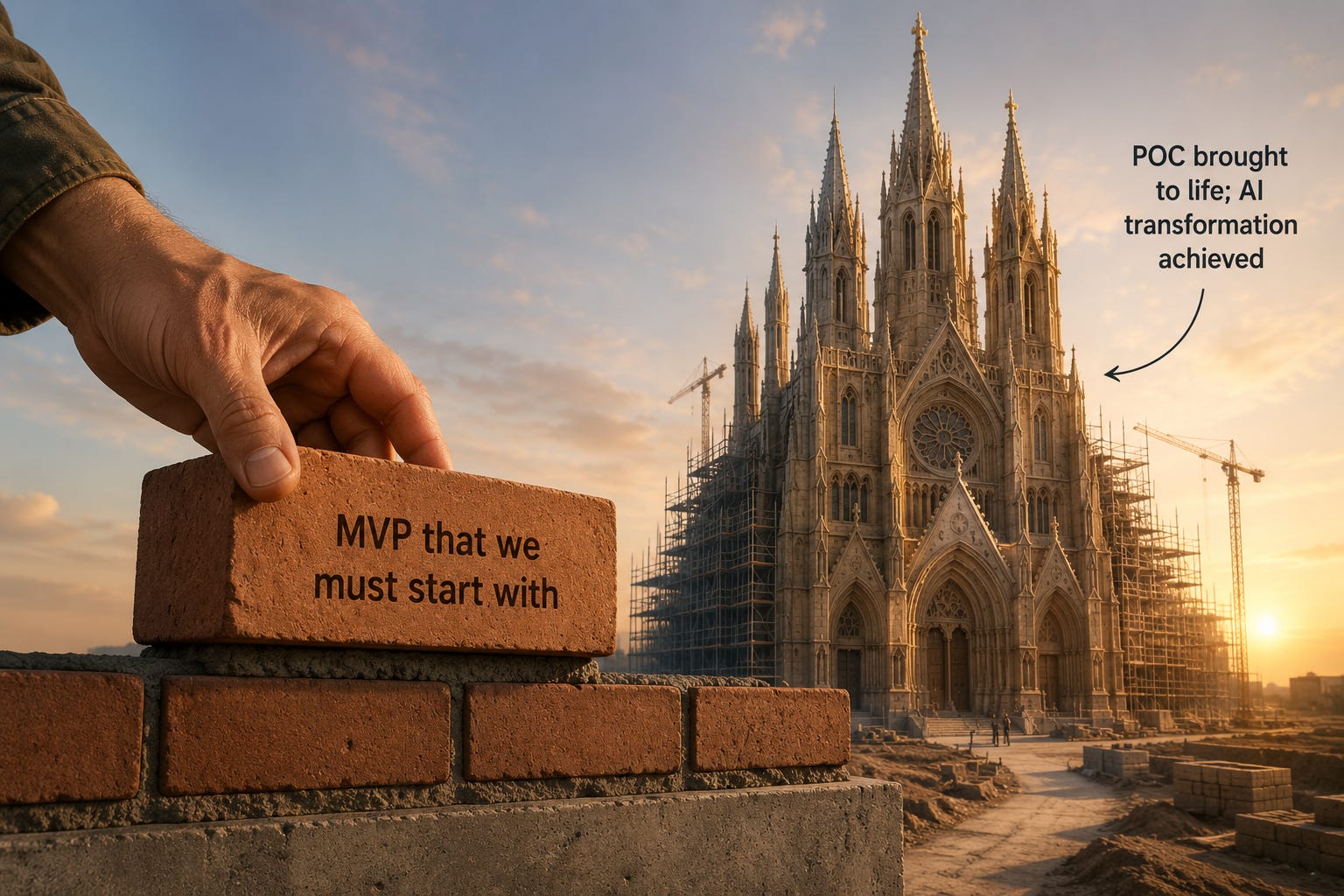
This is where getting a little lean-startup-y is required.
This is where change management is required.
This is where a unified vision of the way business must be done to create the grand cathedral is required.
Unity of Business, R&D, Product, Data Science, Engineering, and Ops
In some circles, the unity around these functions is called agent engineering.
In practice, within companies, I’m seeing that bringing business, research, product, data science, and engineering together is the most important thing leaders must do to enable agentic AI transformation.
Note that Ops also plays a critical role when improving agents in production. However, most companies today are struggling simply to get agents to production.
The reality is that people who truly understand the way your company does business have deep expertise that must be automated and scaled.
They have the vision of what their work, and therefore what your business, will look like in the future. It is essential to cast the problems that these people solve every day into the framework of AI product development.
They are the ones who typically give business analysts, data analysts, and data scientists the “create dashboards” tasks.
The future will look a lot less like “create my dashboard for me” than “create this product for me, I can create my own dashboards.”
It starts with (down)-scoping
Let’s consider the way that startups are built:
1. A proof of concept is conceptualized. This is a high-level, broad vision. This is what business leaders do at large companies; they set a strategic vision. Similar to professors or research scientists writing proposals, this important work must be done before an idea can be brought into the real world. However, as we know, ideas are a dime a dozen; execution is everything.
2. A Minimum Viable Product (MVP) is produced: This is the essential down-scoping step often thought of as a startup-y thing to do, but today is really something critical for all companies undergoing agentic AI transformation. This piece is where the “big transformational idea” (which, of course, is needed) gets brought down to reality and to people who have real problems that can be solved better, faster, and cheaper today. It goes something like this:
“What sector is this a problem for?”
“What specific company is this a problem for?”
“What specific department is this a problem for?”
“What specific person within the department is this a problem for?”
“What is the minimum viable end-to-end solution that you can vibe code up a front end for a quick deployment to a shareable link so that this person can start testing?”
For agentic AI-specific problems, we might ask:
“What role do core in-context learning design patterns like prompting, RAG, agents, fine-tuning, and evals play in the MVP?” In other words, “What are the essential components of my agent’s harness?”
Once we have something to test, we begin iterating:
“What is the feedback from the audience we’re building for, and what are the next iteration steps?”
Thus begins the product development lifecycle.
Note: When this occurs within large organizations, it is much easier than in a new startup. This is because there is no need to specify sector or company, or often a department or person. The (now-product-leader) business person has already done this as the hand-raising expert with the transformational agentic AI idea they’d like to undertake. Typically, within large organizations, these people are already working on these ideas today. The problem? They’re not sure how to get started bringing the first “brick” of their idea to life as a product with a simple input-output schema that defines a specific interface for a specific user and their unique experience. In the best cases, they themselves are the user and can start dogfooding as soon as an MVP is in place.
Effectively, people with transformational visions for the way agents will roll out in their company must adopt their new roles of 1) a product manager, and 2) an end user who dog foods what their team builds.
They’re basically on their way to becoming startup founders; at least, CEO’s of the first product!
The upskilling issue is glaring here: these business experts must learn many new skills. However, in an AI-assisted world, this is now feasible.
Once an MVP is developed and iterated on by the product leader and a small team, it’s time to 1) get the product in the hands of all other similar users at the company, and, if promising growth ensues, 2) throw away the MVP and build out a scalable engineering solution to the problem that can serve all stakeholders quickly and efficiently. It turns out that if your training program keeps this end in mind, it’s actually a simple transition to make from MVP to a scalable production solution.
The Bottlenecks
The difficulties moving from PoC to MVP is summarized nicely in the idea of the AI product management bottleneck.
“the invention of agentic coding assistants has led to a new builder’s block, where the holdup is deciding what to build” ~ Andrew Ng
Then, moving from MVP to production introduces the production AI engineering bottleneck.
Both bottlenecks occur at the organization level, and both must be solved.
AI Product Management Bottleneck
This is the idea that it’s hard to figure out what to build and why. More specifically, it’s hard to take big-picture PoC ideas that business experts can and make them concrete and tangible as specific digital products.
This is the first brick in the foundation that will become the great cathedral that they envision. There are, of course, many potential first bricks. Moreover, we could spend an indefinite amount of time deciding which one we should put in place first and how to position it.
It’s best to get on with it. That’s where the MVP comes in.
Minimum Viable Product
Most companies already have Claude connected to company data, and developers all have GitHub Co-Pilot via VSCode.
This means your teams can already create MVPs. This is the real breakthrough; there is no friction between anyone in your org and an MVP, so long as it is scoped properly.
Vibe-coded frontends, closed-source LLM APIs, and small batches of data are the only essentials needed to demonstrate a PoC in MVP format.
Are these permanent solutions? No, of course not. They’re MVPs – we use them to test them with our users and decide what to work on next.
However, we must get them into our users’ hands to keep the product development going.
Consider this: How many MVPs at your company will die in people’s Claude or ChatGPT conversations in the next few years because they never got into users’ hands?
The Importance of Excited People and Teams
Working alone is ridiculously hard and works for almost no one who already works for someone else.
Importantly, a vibe-coded app that sits in someone’s personal Claude account is going to die without energy, excitement, and enthusiasm from a team of people working towards a common goal. This is where the product leadership piece of product management must come in.
That simple little app needs to get in front of the right people first. Later, it needs to get hooked up to the right data, the right tools, and the right production systems.
This requires both 1) commitment to the company’s cause and 2) the desire to overcome the bureaucracy that lies ahead.
This is where the team MUST come together; the idea person (from here referred to as “product” person) must come together with the data science/engineering/ops team (from here referred to as “tech” or the “tech person”) to rapidly iterate on this first product (i.e., the first brick in the cathedral). Once it has some traction, it’s time to dispense with the MVP and build out a scalable, fully enabled production solution.
To traverse this entire path, you need your people to feel:
“I am building a cathedral, I am not just laying bricks.”
Thinking question: What is the product-tech ratio in your organization today? What should it be tomorrow?
The Role of Agentic AI Training
In general, we can think about training our agentic AI-enabled organization from the bottom up or from the top down.
From the bottom up, we might train engineers in product and business problems. From the top down, we might think about training business people in product, data, and engineering.
We’ve tried both, and I can say confidently that the best training takes a BOTH-AND approach that is calibrated to the particularities of your company and culture.
This is the all-important foundation for your future. Before the first brick is laid, the foundation must be established. The process begins with building out the wood and/or steel frame into which we’ll pour our concrete. This foundation is shared by all of the builders in your organization.
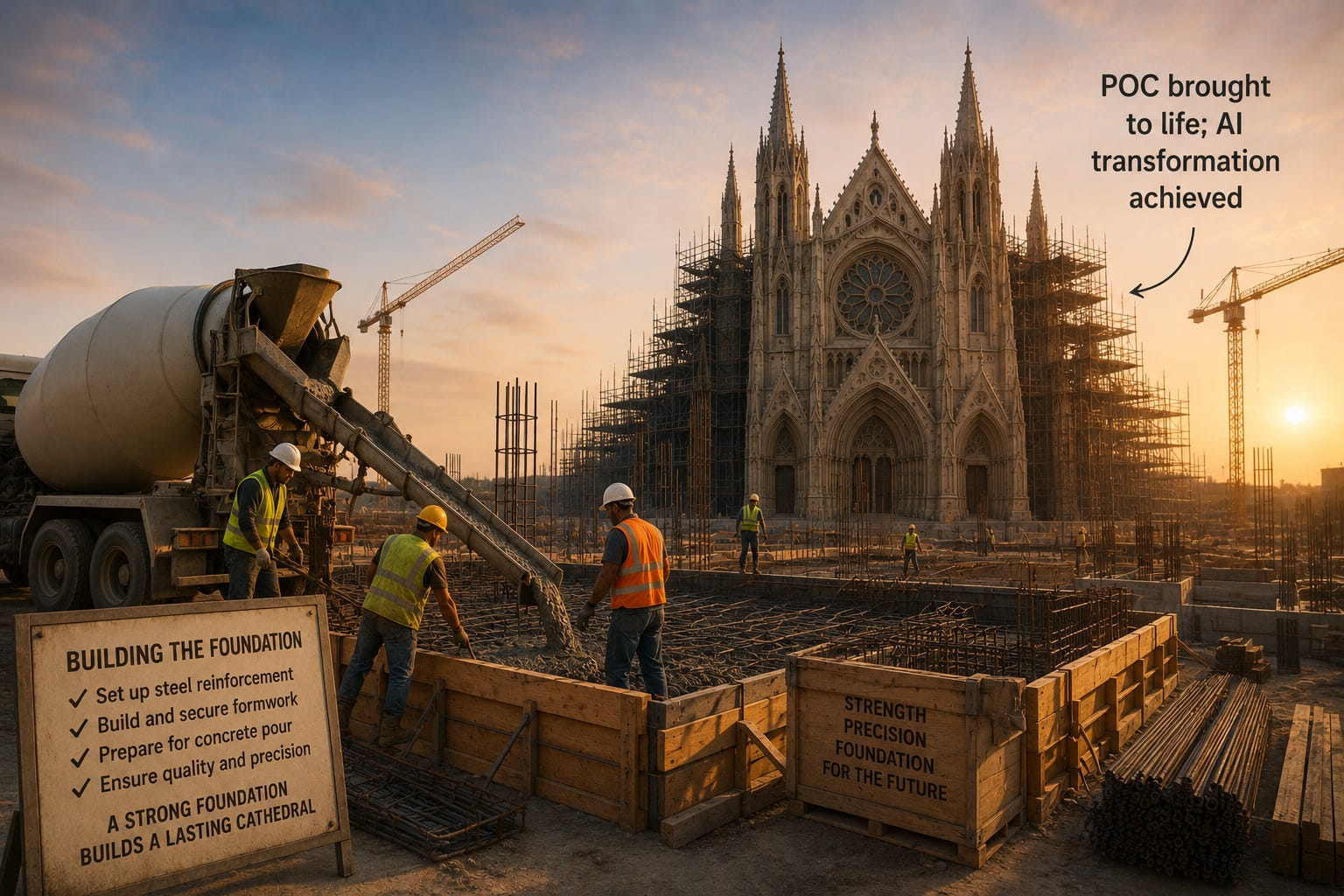
This is the foundation that must take into account: new tools, “Aha moments,” leading-edge people, PoCs and MVPs, managing change, excited people and teams, and finally, a lucid view of where the field is headed.
What is the missing piece for your agentic AI transformation?
—
If you’re looking for training support, don’t hesitate to reach out to me directly at greg@aimakerspace.io with more information about where you’re at in your journey and where you hope to go.
The cathedral vs bricks distinction is the key one. I run a single-person agentic setup - one AI agent that handles research, writing, coding, scheduling, and daily reports. Every time I added a new automation, I had the same choice: quick tool that plugs a gap, or invest another week building toward a coherent system. The difference in long-term output was massive.
The tools that saved me 10 minutes started creating 20-minute debugging sessions three months later. The coherent pieces compounded. I think the organizational version of this is the same thing at a bigger scale. The aha moment you mention is when someone stops optimizing the tool and starts seeing the shape of the system they are building toward.